


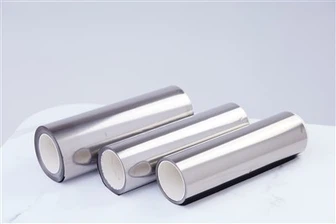
Thickness 0.005mm Silver-plated Titanium Foil
Physical Properties Thickness and Dimensional Accuracy : With a thickness of only 0.005 mm, this foil offers high flexibility and conformability. Advanced manufacturing techniques ensure precise thickness control, minimizing dimensional variations and enabling its use in applications where...
Product Introduction
Physical Properties
Thickness and Dimensional Accuracy: With a thickness of only 0.005 mm, this foil offers high flexibility and conformability. Advanced manufacturing techniques ensure precise thickness control, minimizing dimensional variations and enabling its use in applications where tight tolerances are crucial.
Density: The density of the silver-plated titanium foil is influenced by both the titanium substrate and the silver coating. Titanium has a relatively low density compared to many metals, and the addition of the silver layer, which has a higher density, results in a composite density that lies between the densities of pure titanium and pure silver. This property affects the foil's weight and mechanical behavior.
Electrical Conductivity: The silver coating significantly enhances the electrical conductivity of the foil. Silver is one of the best conductors of electricity, and even a thin layer can drastically improve the electrical properties of the titanium substrate. This makes the silver-plated titanium foil suitable for applications where efficient electrical conduction is essential, such as in electronic interconnects and conductive patterns.
Thermal Conductivity: Similar to electrical conductivity, the silver coating also improves the thermal conductivity of the foil. Titanium has decent thermal conductivity on its own, and the addition of silver further enhances heat transfer capabilities. This property is beneficial in applications where heat dissipation is critical, such as in power electronics and heat exchangers.
Mechanical Properties
Strength and Toughness: Titanium provides excellent strength and toughness to the foil. Despite its thinness, the titanium substrate offers good resistance to deformation and mechanical damage. The silver coating, while relatively soft compared to titanium, does not significantly compromise the overall mechanical integrity of the foil. In fact, the combination of titanium's strength and silver's ductility can result in a material with a good balance of mechanical properties.
Flexibility and Conformability: The thinness of the foil (0.005 mm) endows it with high flexibility and conformability. It can be easily bent, folded, or shaped around complex geometries without cracking or breaking. This property makes it ideal for applications in flexible electronics, such as wearable devices and foldable displays, where the material needs to conform to the contours of the device.
Adhesion of Silver Coating: The adhesion of the silver coating to the titanium substrate is a critical mechanical property. Poor adhesion can lead to delamination or peeling of the silver layer during use, compromising the performance of the foil. Through proper surface treatment and plating techniques, a strong bond between the silver and titanium can be achieved, ensuring the durability and reliability of the silver-plated titanium foil.
Chemical Properties
Corrosion Resistance: Titanium has excellent corrosion resistance due to the formation of a stable oxide layer on its surface. The silver coating further enhances this property in certain environments. For example, in environments where both chemical corrosion and electrochemical reactions are possible, the combination of titanium's oxide layer and silver's chemical stability provides enhanced protection against corrosion. This makes the silver-plated titanium foil suitable for use in harsh chemical environments, such as in chemical processing equipment and marine applications.
Chemical Stability: The foil exhibits good chemical stability over a wide range of temperatures and pH values. It is resistant to many acids, alkalis, and salts, although the specific chemical resistance may vary depending on the thickness and quality of the silver coating and the surface treatment of the titanium substrate. This chemical stability allows the foil to be used in various industrial and scientific applications where exposure to different chemicals is expected.
Applications
Electronics and Electrical Engineering:
Interconnects and Conductive Traces: In printed circuit boards (PCBs) and integrated circuits (ICs), the high electrical conductivity and flexibility of 0.005 mm silver-plated titanium foil make it an ideal choice for interconnects and conductive traces. Its thinness allows for miniaturization of electronic components, while its corrosion resistance ensures reliable signal transmission over time.
Electrodes and Sensors: The foil can be used as electrodes in various electrochemical devices, such as batteries, fuel cells, and sensors. Its good electrical conductivity and chemical stability enable efficient electron transfer and accurate sensing of chemical or physical parameters.
Optics and Photonics:
Reflective Coatings: Silver's high reflectivity makes the silver-plated titanium foil suitable for use as reflective coatings in optical devices. It can be used in mirrors, optical filters, and laser resonators to enhance light reflection and control the propagation of light.
Flexible Optoelectronic Devices: In flexible optoelectronic applications, such as flexible displays and wearable photonic devices, the foil's flexibility and conductivity make it a promising material for transmitting electrical signals and reflecting or transmitting light.
Energy Storage and Conversion:
Battery Electrodes: In batteries, the silver-plated titanium foil can serve as a current collector, improving the electrical conductivity of the electrode and enhancing the battery's performance. Its corrosion resistance and chemical stability are beneficial for the long-term operation of batteries, especially in high-temperature or chemically aggressive environments.
Fuel Cell Components: The foil can also be used in fuel cells as a bipolar plate or current collector. Its good electrical conductivity and chemical resistance help in the efficient transfer of electrons and the management of reactants and products within the fuel cell.
Aerospace and Defense:
Lightweight Structural Components: The combination of titanium's high strength-to-weight ratio and the foil's thinness makes it suitable for use as lightweight structural components in aerospace and defense applications. It can be used in the manufacture of aircraft skins, satellite components, and other structures where weight reduction is critical.
Electromagnetic Shielding: The silver coating provides excellent electromagnetic shielding properties, making the foil useful for protecting sensitive electronic equipment from electromagnetic interference in aerospace and military systems.
Hot Tags: thickness 0.005mm silver-plated titanium foil, China thickness 0.005mm silver-plated titanium foil manufacturers, suppliers, factory, Ti15333 Titanium Plate, High Purity Tin Foil, Titanium Speaker Diaphragm, Electrolytic Copper Foil for Rigid Circuit Boards, tungsten foil, 200 Nickel Foil UNS N02200
You Might Also Like




Send Inquiry
